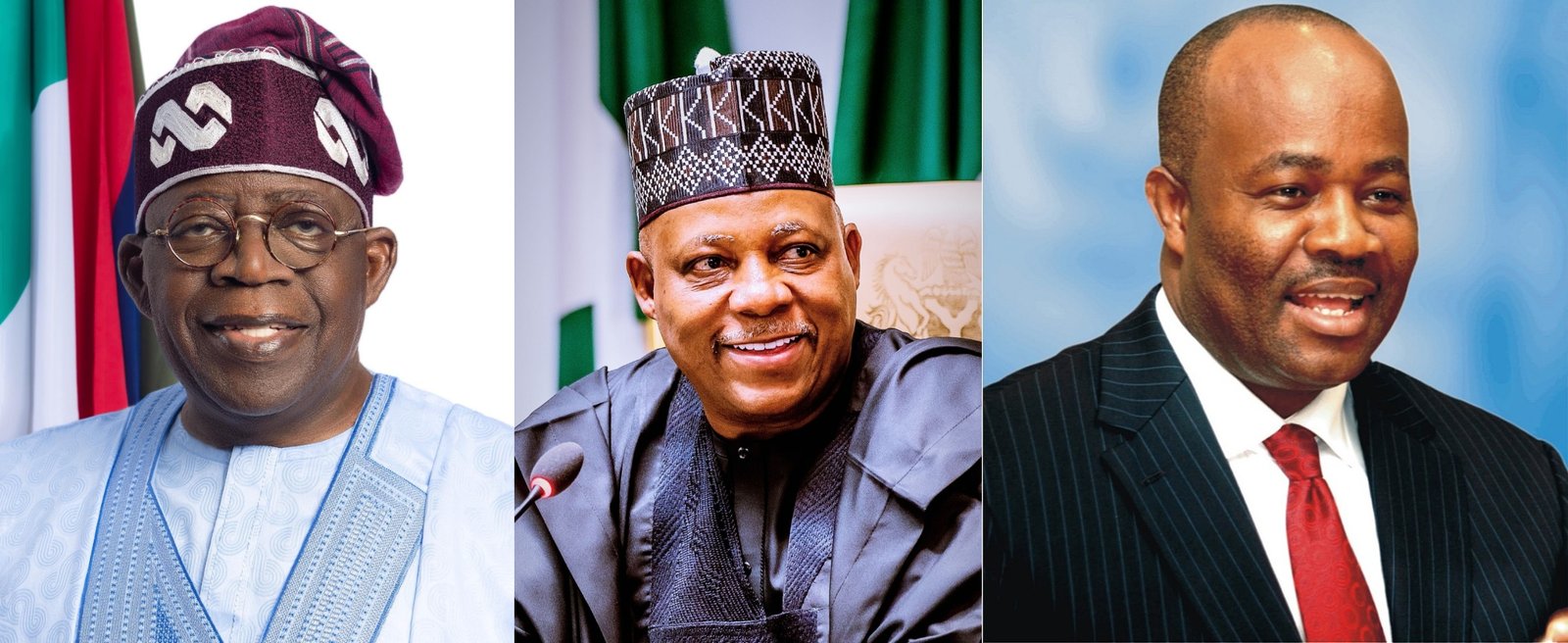
In Nigerian politics, the loudest battles are rarely the most consequential. While public attention gravitates toward presidential ambitions, party defections, and headline-grabbing rallies, the real struggle often unfolds quietly—behind closed doors, in coded statements, selective omissions, and symbolic gestures that signal far more than they say.
As the country inches toward the 2027 general elections, one such struggle has begun to dominate elite political calculations: the fate of the vice-presidency and the fragile equilibrium it sustains within Nigeria’s power architecture.

At the centre of this debate is a deceptively simple question: Will President Bola Ahmed Tinubu retain Vice President Kashim Shettima as his running mate in 2027? Beneath that question lies a complex web of regional anxieties, religious balancing, party cohesion, opposition strategy, and the survival instincts of key power brokers—including Senate President Godswill Akpabio.
Despite persistent rumours and orchestrated speculation, a close reading of political signals suggests that Tinubu is far more constrained than his critics or supporters often assume. The vice-presidential slot is not merely a matter of personal preference or tactical adjustment; it is a structural pillar in Nigeria’s unwritten but rigorously enforced power-sharing formula.
The Politics of Omission: How the Rumours Began
Speculation over Shettima’s political future did not emerge from thin air. It was manufactured through omission—one of the oldest techniques in Nigerian elite politics. In mid-2025, during a meeting of All Progressives Congress (APC) stakeholders from the North-East in Gombe, party leaders endorsed Tinubu for a second term without explicitly mentioning Shettima. In a political culture where silence is rarely accidental, the omission was immediately interpreted as a signal: something was being tested.
The backlash was swift and visceral. Delegates from Borno State, Shettima’s political base, erupted in protest. Chants of “No Shettima, no APC in the North-East” filled the venue. Chairs were hurled. The meeting collapsed into chaos.
Shortly afterward, another symbolic slight followed. At a zonal public hearing in Maiduguri, a banner featuring APC leaders from the North-East displayed President Tinubu, five APC governors from the zone, and the party’s National Legal Adviser. The Vice President was absent. Whether deliberate or careless, the effect was the same. The message received in the North-East was unmistakable: Shettima’s position was being questioned without consultation.
In Nigerian politics, such moments are not mere public relations errors. They are trial balloons—ways of gauging resistance before committing to a course of action. In this case, the resistance was overwhelming.
The Muslim–Muslim Ticket: A Winning Formula or a Political Burden?
To understand why replacing Shettima would be politically hazardous, one must revisit the logic—and consequences—of the 2023 Muslim–Muslim ticket. When Tinubu chose Shettima as his running mate, the decision triggered one of the most intense political controversies since Nigeria’s return to civilian rule. Religious groups, civil society organisations, and opposition parties framed the ticket as exclusionary and provocative in a religiously plural society. Yet the APC won.
The victory did not erase the controversy, but it established a crucial political fact: the Muslim–Muslim ticket was electorally viable. In core northern states, particularly in the North-East and North-West, the ticket mobilised turnout and consolidated APC dominance. It also neutralised internal party competition by presenting a united northern–southern Muslim front.
Changing that formula in 2027 would carry an implicit admission that the 2023 strategy was flawed—or that the party lacked confidence in defending it again. For a president seeking re-election, such a signal would be politically destabilising.
More importantly, the Muslim–Muslim ticket is not just a campaign strategy; it is now embedded in the APC’s internal balance of power. Removing Shettima would not merely alter the ticket—it would reopen unresolved grievances that the party has deliberately kept frozen.
Shettima as Political Symbol, Not Just Deputy
Kashim Shettima’s significance extends beyond his constitutional role. He represents the North-East’s political inclusion in a system that has historically marginalised the region despite its electoral importance and security challenges.
For the APC, Shettima’s presence serves multiple purposes: It reassures the North-East that its loyalty in 2023 was not transactional. It anchors the party’s support in Borno, Yobe, and Adamawa. It provides continuity in a region where political alienation can quickly translate into electoral disengagement.
The reaction in Gombe was not merely about Shettima as an individual; it was about collective regional dignity. Nigerian politics has repeatedly shown that regions respond more fiercely to perceived disrespect than to policy disagreements.
Dropping Shettima would be read in the North-East as a repudiation—not only of a person, but of a pact.
Loyalty, Competence, and the Absence of Rivalry
Another factor working in Shettima’s favour is his conduct in office. Unlike several vice presidents in Nigeria’s history, Shettima has avoided public rivalry with his principal. He has not cultivated an independent power base, issued contradictory policy signals, or positioned himself as an alternative centre of authority.
He chairs the National Economic Council, engages policy debates with technocratic depth, and largely stays out of partisan theatrics. This low-profile competence may not generate headlines, but it is precisely what many presidents value in a deputy—especially one contemplating a second term.
Tinubu’s political career has been shaped by a keen sensitivity to loyalty. While he replaced deputy governors during his tenure as Lagos State governor, the presidency operates under different constraints. A vice president is not easily discarded without consequences. In this sense, Shettima represents a known quantity in an unpredictable environment.
The North-Central Question: Demand Without Consensus
Much of the agitation for a new vice-presidential candidate has been framed around the North-Central’s demand for inclusion. On paper, the argument appears compelling: the region has not produced a vice president since the short-lived tenure of Goodluck Jonathan’s first term arrangement, and it occupies a religiously diverse middle ground.ground
In practice, the demand lacks elite coherence.
The North-Central APC Forum itself has cautioned against replacing Shettima, warning that such a move could destabilise the party and weaken Tinubu’s northern base. The forum has instead signalled interest in positioning the region for the presidency in 2031—a more strategic long-term objective.
More critically, the region lacks a consensus Christian candidate with nationwide grassroots appeal and an established political machine capable of compensating for potential losses in the North-East or North-West.
In electoral terms, substitution without equivalent value is political self-sabotage. Opposition Calculus: Why Change Could Backfire; The APC’s internal debate cannot be divorced from opposition dynamics.
If the opposition consolidates around a credible southern candidate—most notably Peter Obi, now aligned with the African Democratic Congress (ADC) coalition—the electoral map becomes more competitive than in 2023.
In that scenario, replacing Shettima would not necessarily attract new voters. Many northern Christian minorities who supported Obi in 2023 did so out of ideological affinity and protest sentiment, not running-mate arithmetic. There is little evidence that a Christian vice-presidential candidate would automatically reverse that trend.
Conversely, alienating core northern Muslim voters—particularly in the North-East—could reduce turnout or encourage protest abstention. As one APC stakeholder bluntly warned, “You don’t weaken your base to chase uncertain gains.”
Foreign Pressure and the Sovereignty Narrative
Another layer of speculation involves alleged international pressure—particularly from Western governments—urging Nigeria to abandon the Muslim–Muslim ticket in the interest of religious balance. APC leaders have publicly dismissed such narratives, framing them as an infringement on Nigeria’s sovereignty. Whether or not such pressure exists, it has limited practical influence on domestic party calculations.
Nigerian elections are decided less by external approval than by internal coalition management. Any decision perceived as externally imposed would likely provoke nationalist backlash within the party.
The Villa’s Position: Silence as Confirmation
Despite sustained speculation, the Presidency has neither hinted at nor endorsed a change in the vice-presidential ticket. On the contrary, senior insiders have repeatedly dismissed the rumours.
One source quoted by THISDAY was unequivocal: “The president will run with Shettima. You can file it away.”
In Nigerian politics, such certainty—delivered off the record—is rarely accidental. It reflects an understanding that reopening the vice-presidential question would create more problems than it solves.
The Akpabio Variable: When the VP Question Reaches the Senate
The implications of Tinubu’s 2027 strategy extend beyond the presidential ticket. They reach deep into the National Assembly—particularly the office of the Senate President.
Godswill Akpabio’s emergence as Senate President in 2023 was not ideologically neutral. It was part of a compensatory arrangement designed to soften backlash against the Muslim–Muslim ticket. A Christian from the South-South leading the Senate helped project inclusiveness at a sensitive moment.
If Tinubu retains Shettima, Akpabio’s position remains structurally defensible. If Tinubu replaces Shettima with a Christian running mate, the equation changes.
Religious Balancing and the Senate Presidency
Nigeria’s political system operates on an unwritten but rigid balancing formula. When the presidency and vice presidency tilt in one religious direction, other strategic offices are adjusted accordingly.
A Christian vice president in 2027 would immediately weaken the rationale for a Christian Senate President. Within the APC, pressure would likely mount to rebalance the equation—possibly by shifting the Senate presidency to a Muslim, potentially from the North.
Read also:
- Yusuf’s defection shakes Kano politics as Ganduje signals possible reconciliation with Kwankwaso
- Gov. Oborevwori swears in 6 new judges
- Wike isn’t APC leader in Rivers, party chieftain counters Abe
This would not necessarily be a judgment on Akpabio’s performance. Nigerian political history shows that Senate presidents are often casualties of structural realignment rather than legislative failure.
From Evan Enwerem to Chuba Okadigbo, Adolphus Wabara to Bukola Saraki, the pattern is consistent: when the political equation changes, the gavel moves.
Akpabio’s Leverage—and Its Limits
Akpabio is not politically defenceless. He brings executive experience, cross-party relationships, and a proven capacity to manage legislative politics. His role in stabilising the 10th Senate and maintaining executive–legislative harmony works in his favour.
However, Senate leadership in Nigeria ultimately depends on presidential backing. If the presidency recalibrates its priorities around religious or regional balance, individual leverage may prove insufficient.
Northern VP Aspirants and the 2031 Horizon
Beyond the APC, the broader political landscape reveals a surge in northern politicians angling for vice-presidential relevance—particularly within the ADC opposition coalition. Figures such as Aminu Tambuwal, Rabiu Kwankwaso, Nasir el-Rufai, Ibrahim Shekarau, and others are positioning themselves not merely for 2027, but for 2031.
The logic is straightforward: in a zoning environment that favours a southern presidency in 2027, the vice presidency becomes the most viable platform for future northern ambition.
This explains why the VP slot has become as fiercely contested as the presidency itself.
Vice Presidency as Political Capital
History supports this strategy. Atiku Abubakar, Peter Obi, and even Yemi Osinbajo all used the vice presidency to build national profiles that later translated into presidential viability.
In this context, the scramble for the VP slot is not about subordination; it is about positioning.
Stability Over Experimentation
As 2027 approaches, President Tinubu faces a familiar Nigerian dilemma: how to manage competing demands without destabilising the coalition that brought him to power. All available evidence suggests that replacing Kashim Shettima would introduce more risk than reward. It would antagonise the North-East, unsettle the APC’s internal balance, complicate religious arithmetic, and trigger ripple effects extending to the National Assembly.
Retaining Shettima, by contrast, offers continuity, predictability, and coalition stability.
In Nigerian politics, the most powerful decisions are often those that preserve equilibrium rather than chase novelty. For Tinubu, the vice-presidential question is less about reinvention than about consolidation.
And in that calculus, the quiet logic of power points toward one conclusion: the Tinubu–Shettima ticket is likely to remain intact—not because it is flawless, but because altering it would be politically reckless.